
Welcome to Wes Campbell's Reseach Group at UCLA Physics & Astronomy
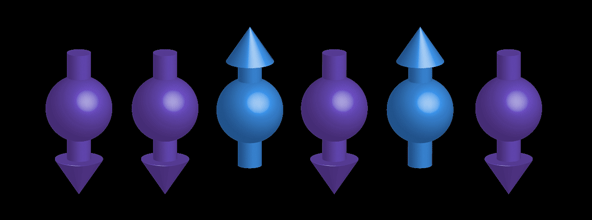 Our research uses ultra-cold atoms and molecules to learn about the physical processes that permeate our world.
We are specifically focused on the physics of quantum information, which includes advanced sensing, simulation, and computing applications.
We use gas and liquid phase atoms and molecules as tiny computers to perform tasks that cannot be simulated on classical computers. Our approach is to focus on novel species and novel ways to control them to leverage the built-in "quantumness" of these molecules for higher performance in these applications.
Latest News
 Potato-Battery Ion Trap
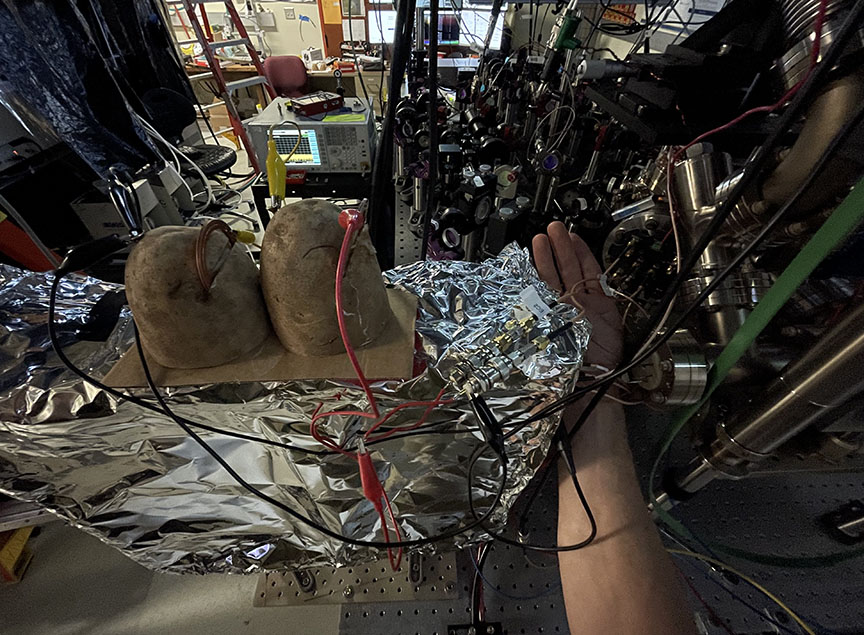
June 16, 2026: Did you know scientists can trap atomic ions at a thousandth of a degree above absolute zero with organic produce? This week, Campbell-group graduate student Drew Parks swapped his power supply for a potato battery to produce the DC voltage that confines Yb+ ions in a radio-frequency Paul trap. The ions were then laser-cooled and left in the dark trap overnight. And the next morning? Farm-fresh ions were waiting in the trap, which Campbell-group graduate student Will Liu coined ``farm-to-(optical)-table sustanable science."
 Designer molecules
October 3, 2025: Molecules that can repeatedly scatter light without bleaching in gas phase are proposed for future applications in quantum information processing and precision measurement. In collaboration with chemists and physicists, we investigated the possibility of a limiting size for such molecules, finding no evidence for this in the case of moleule growth through attaching adamantanes. The results have been published in a paper in Nature Chemistry.
 Quantum Error Correction in Single Atoms
December 23, 2024: Quantum computers process analog information, and are therefore highly susceptible to noise. Quantum error correction (QEC), which "digitizes" the process, allows a perfect computation to be performed by an imperfect device (a feature not available with classical analog computing). Unfortunately, QEC tends to be costly, requiring many extra atoms in atomic processors. To address this, we have recently introduced QEC codes that are hosted within single atoms and tailored specifically to electromagnetic errors, which are the dominant type that occur in atomic processing.
 Liquid-phase magnetometry
August 9, 2024: Atomic vapor cells can be employed for high-precision measurement of magnetic fields, but their vapor density cannot be increased arbitrarily without compromising their sensitivity. In a recently-published article in Science, we intorduce a liquid-phase molecular solution that may allow much higher spin densities than vapor cells. The trade-off is that these molecular systems have substantial broadening from interactions with the solvent. Whether these problems can be overcome remains a topic of current research.